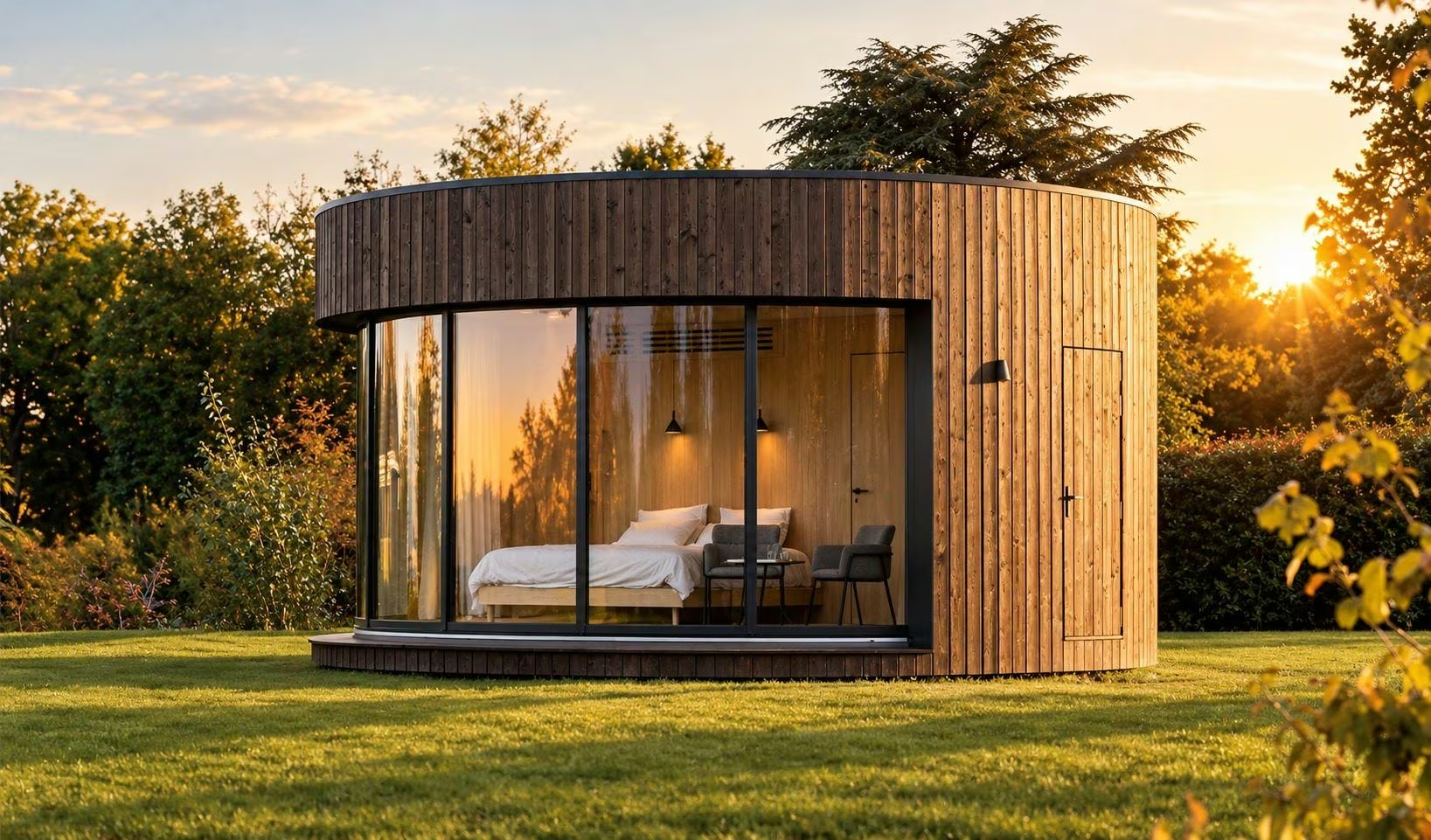
Does a compact home make everyday life easier, or harder? The question comes up often, and the honest answer fits in one sentence: NÖMA has no proprietary study measuring this effect, and no scientific study settles the link between floor area and well-being in a universal way. What can be done, instead, is to rely on a recognised framework to understand what, in a home, genuinely matters for the health and quality of life of its occupants, whether it is 25 sqm or 150 sqm.
Understanding the topic
In 2018 the World Health Organization published housing and health guidelines that are recognised internationally. The document identifies four families of factors documented as having a real impact on occupants' health: inadequate living space (crowding), indoor temperature (too low or too high), injury hazards within the home, and accessibility for people with reduced mobility. The WHO notes that improving housing on these points can increase occupants' quality of life and reduce certain health risks.
This framework does not say that a small home is bad, nor that it is good: it shifts the question. What is documented is crowding, meaning insufficient space relative to the number of occupants and how the home is actually used, not floor area in absolute terms. A well-designed compact home, sized for its occupants' real use, is not the same thing as an overcrowded home. That distinction, between size and fit, is worth knowing before asking whether a small space supports well-being.
Deep exploration
From a design standpoint, the first variable that separates a compact space that is pleasant to live in from one that is not is storage. In a reduced volume, every object left visible or poorly stored takes up disproportionate room, both physically and visually. Storage planned from the outset, built into the structure rather than added afterwards, limits that clutter and keeps circulation legible, a point we also develop when discussing setting up an independent workspace, where the same logic applies to sharing a small volume between several uses.
Indoor temperature, for its part, is one of the four factors identified by the WHO, and it depends directly on the quality of a building's insulation, not on its floor area. At NÖMA, insulation is part of the habitable baseline included at no extra cost across the entire Tiny and Maison collections. Heating and air conditioning follow a different rule: they are included on the Span, Pod, Line and Vista models; for the rest of the Tiny range, including Fold, this information is not publicly documented at this time, and air conditioning is offered there as an option rather than a standard fitting.
Practical guidance
Duration and type of use also change how a compact space is experienced. An independent office used a few hours a day, a secondary home occupied a few weeks a year, and a primary residence lived in year round do not place the same demands on the same volume: the more intense and prolonged the use, the more space organisation and storage matter. This is a question of fit between the project and its real use, far more than a general question of well-being.
Before judging whether a compact home will or will not suit someone, it is therefore more useful to check concrete criteria than to look for a universal answer on well-being: is the floor area suited to the number of occupants and their real use of the place, is storage built into the design rather than added afterwards, are insulation and, depending on the model, heating or air conditioning documented for the home being considered, and does the site's orientation allow for good natural light. These criteria, which can be checked model by model, give a sturdier basis than a general promise of well-being.
Architectural perspective
At NÖMA, we believe a well-designed compact home does not need psychological arguments to justify itself: it needs storage planned from the floor plan, real insulation, and an honest fit with its intended use. Well-being, if it comes, comes from that fit, not from size on its own.
Sources
Verified external sources, cited below.